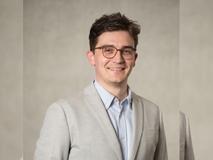
Meet Alexandre Anthis, CEO & Founder of Veltist. The medtech startup is developing a smart surgical sealant patch that prevents and detects digestive leaks after abdominal surgery. In October, Alexandre and the other nine Swiss National Medtech Team members will fly to Boston on a business development and investor roadshow.
 Name and role: Dr. Alexandre Anthis, CEO & Founder of Veltist AG
Location: Zurich, Switzerland
Nationality: Swiss-Greek
Graduated from: ETH Zurich and Empa
Prior role: Passionate inventor and chemist
Founding team members: Dr. Alexandre Anthis (sole founder)
Number of employees: 7 and growing
Money raised: CHF 6M in dilutive and non-dilutive financing to date
What does your product or solution do, and what makes it unique?
Veltist is developing AnastoSeal, a surgical sealant patch created as a holistic solution to one of modern surgery's greatest problems. It does two things at once. It seals the reconnection surgeons create on organs of the abdominal cavity, and does so in a way that keeps digestive fluids contained if and when they appear, while also allowing surgeons to monitor and confidently confirm deterioration, if it ever happens, before symptoms start to appear. It achieves this while being completely embedded in the existing hospital ecosystem and without any electronics, using simple ultrasound and CT to give doctors insight into these areas of reconnection. That is what makes the technology unique: it is the first of its kind capable not only of sealing under the conditions of a digestive leak, but also of detecting impending leaks, all while being a biodegradable and absorbable device. Our lead indication is distal pancreatectomy, one of the most feared surgeries for the detrimental effects of leaks.
What trend or shift in your industry is currently creating the biggest opportunity for you?
The industry is actively on the lookout for better tools and better materials to mitigate and eliminate complications such as surgical leaks, and to move away from intermediate solutions that too often end in reoperations. More broadly, surgical care is shifting from reacting to complications to catching them early, driven by pressure on hospitals to reduce reoperations, length of stay, and the high cost of post-operative leaks. As a result, well-crafted innovations and technologies that are designed to integrate seamlessly into the existing hospital ecosystem are becoming a must in order to solve a complicated problem. That combination of clinical demand and purpose-built, easily adopted technology is what opens the door for AnastoSeal.
How did the idea for your startup originate?
It started from the friendship between a surgeon and a materials engineer, and became real when a chemist joined them. Almost nine years ago, a surgeon - frustrated that even his best work could not stop some patients from deteriorating after surgery - kept asking why excellence in the operating room was not translating into better outcomes. Out of that frustration, and the bond between clinical insight, materials science, and a shared obsession with truly game-changing innovation, AnastoSeal came to life.
Which market are you addressing, and what potential do you see for your startup in that market?
We address the visceral and abdominal surgery market, specifically the post-operative leaks market, a total addressable market of around USD 7 billion. The need is big: more than 10% of surgeries experience detrimental leaks, and every leak costs on average USD 40,000 per patient (these numbers are similar worldwide). We believe AnastoSeal is the first device specifically made to mitigate and eradicate the problem of post-operative leaks. With that in mind, we are building a technology for every operation performed on the abdominal cavity, and for every reconnection that carries the risk of an unacceptable post-operative leak. From that, we estimate at least USD 1 billion directly addressable in the early years that follow.
What impact do you want your technology to have five years from now?
In five years, I want surgical sealants that can confidently assess the healing or deterioration of high-risk anastomoses to be a reality, and not a luxury. I want this to be a technology that can be used everywhere, in every hospital in the world, with equipment that already exists. Concretely, that means containing leaks in their early days when they start to occur, detecting them before they turn into life-threatening events, and allowing surgeons to put patients straight on the road to recovery instead of performing intermediate surgeries. It means giving surgeons confidence and data they have never had before. If a routine question for the surgical team becomes "what do we see in AnastoSeal - what does the patch tell us?", we will have changed how this class of complication is managed.
What major challenges have you faced so far?
The biggest challenge is understanding what I cannot anticipate on my own - seeing the issues that sit nine months to a year down the line. On top of that, bringing a high-risk implant forward in a demanding funding environment has taught me that patience, resilience, hard work, and sticking to the fundamentals are the winning strategy. Bringing every aspect of the venture forward robustly and together is both the rewarding and the difficult part of every day.
What motivates you on tough days?
My team, and the goal we are working towards: helping both patients and surgeons. The surgeons and their feedback keep me going, and - most exciting of all - watching a great technology take its rightful place day by day in our scale-up operation and, ultimately, in clinical routine in the hands of surgeons.
Why did you decide to join the Venture Leaders Roadshow, and what are you most excited about?
The Venture Leaders Roadshow is legendary for opening up the most important market for medical technologies, and especially for implants - a market that is crucial for us to understand and engage with, all the more as our venture and our mission mature. Venture Leaders and the seasoned professionals at Venturelab make that prospect genuinely exciting. What I am most excited about is, on one hand, meeting US capital - both established venture firms and medtech-focused funds - and, on the other, refining our US regulatory and FDA pathway so we can better anticipate market entry in the US. The trip is also a chance to reconnect with important clinical collaborators, friends, and existing partners.