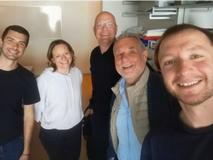
Meet Boris Sevarika, CEO of NanoZymeX. The biotech employs nanotech and protein therapeutics to target rare genetic diseases. Boris and the other nine Swiss National Biotech Team members will travel to Boston in June.
 Name: Boris Sevarika
Location: Basel, Switzerland
Nationality: Serbian
Graduated from: Heidelberg University (Staatsexamen, Pharmazie), Saarland University (Master of Science, Pharmacy), and University of Basel (PhD, defense upcoming soon)
Prior role: Graduate Research Assistant at the University of Basel (PhD Student)
Founding team members: 3
Number of employees: 3.5 FTE
Money raised: 1.4M (through different grants, direct and indirect department contributions, from the Innovation Office of the University of Basel, and from Venture Kick)
What does your product or solution do, and what makes it unique?
Patients with lysosomal storage diseases lack a key enzyme, causing toxic buildup that damages organs over time, like a city without waste workers. Current enzyme replacement therapies often fail to reach target cells efficiently, limiting their effect. NanoZymeX uses lipid nanoparticles to deliver many enzyme molecules directly into cells and protect them in circulation. This improves delivery to lysosomes and aims to make existing enzyme therapies more effective.
What trend or shift in your industry is currently creating the biggest opportunity for you?
In lysosomal storage disorders like Pompe disease, recent efforts have focused on improving the enzyme itself, including better cellular targeting. While this has led to some advances, it has not produced clearly better clinical outcomes. This shows the main limitation is delivery, not the enzyme. NanoZymeX instead focuses on improving delivery using lipid nanoparticles to transport enzymes into cells. With first-generation therapies nearing patent expiry, there is growing demand for differentiated next-generation approaches.
How did the idea for your startup originate?
The idea originated during my PhD in the group of Prof. Dr. Scott McNeil at the University of Basel, where we worked on enzyme delivery for lysosomal storage disorders. We focused on a clear problem: active enzymes exist, but they do not efficiently reach target cells to halt disease progression. This led us to explore lipid nanoparticle strategies for improved intracellular delivery. As results accumulated, it became clear the approach could overcome key limits of existing therapies and may translate into clinical impact. That was the foundation of NanoZymeX.
Which market are you addressing, and what potential do you see for your startup in that market?
We are targeting lysosomal storage disorders, starting with Pompe disease. This is a multi-billion-dollar market with established therapies, but persistent unmet needs in efficacy and patient burden. The opportunity lies in improving existing standards of care in a clinically meaningful way. Beyond Pompe, the same platform can be applied across a wide range of enzyme-based therapies, giving us the potential to build a broad and scalable pipeline.
What impact do you want your technology to have five years from now?
Within five years, we aim to demonstrate that solving delivery can fundamentally change the effectiveness of enzyme therapies. That means stronger functional outcomes for patients, reduced treatment burden, and fewer immune-related complications. More broadly, we want to contribute to a shift in how biologics are developed, where intracellular delivery is treated as a central design parameter rather than a limitation.
What major challenges have you faced so far?
We are combining two highly complex fields, nanomedicine and biologics, which require solving formulation, stability, manufacturing, and biological performance challenges at once. Working in rare diseases also adds complexity, as the conditions and current treatment limits often need to be explained in detail to partners and investors. So far, our data strongly supports the approach, which builds confidence as we move forward. Switzerland provides strong support through programs like Venture Kick, the University of Basel Innovation Office, and Innosuisse, helping bridge early-stage gaps.
What motivates you on tough days?
What motivates me is the gap between what current therapies promise and what patients actually experience. Even with available treatments, many patients continue to lose function over time. Talking with a patient for 5 or 10 minutes is more than enough to understand how important the development of the new therapies is. Knowing that there is a realistic path to improving this outcome is a strong driver. It gives a clear sense of purpose to the work we are doing.
Why did you decide to join the Venture Leaders Roadshow, and what are you most excited about?
The Venture Leaders Biotech Roadshow is a unique opportunity to engage directly with top-tier investors and industry experts in a highly competitive environment. For us, it is a chance to position NanoZymeX internationally and to stress-test our strategy and messaging. I am particularly excited about building relationships with partners who understand both the scientific depth and the commercial potential of what we are developing.